
How Fascism Works Review
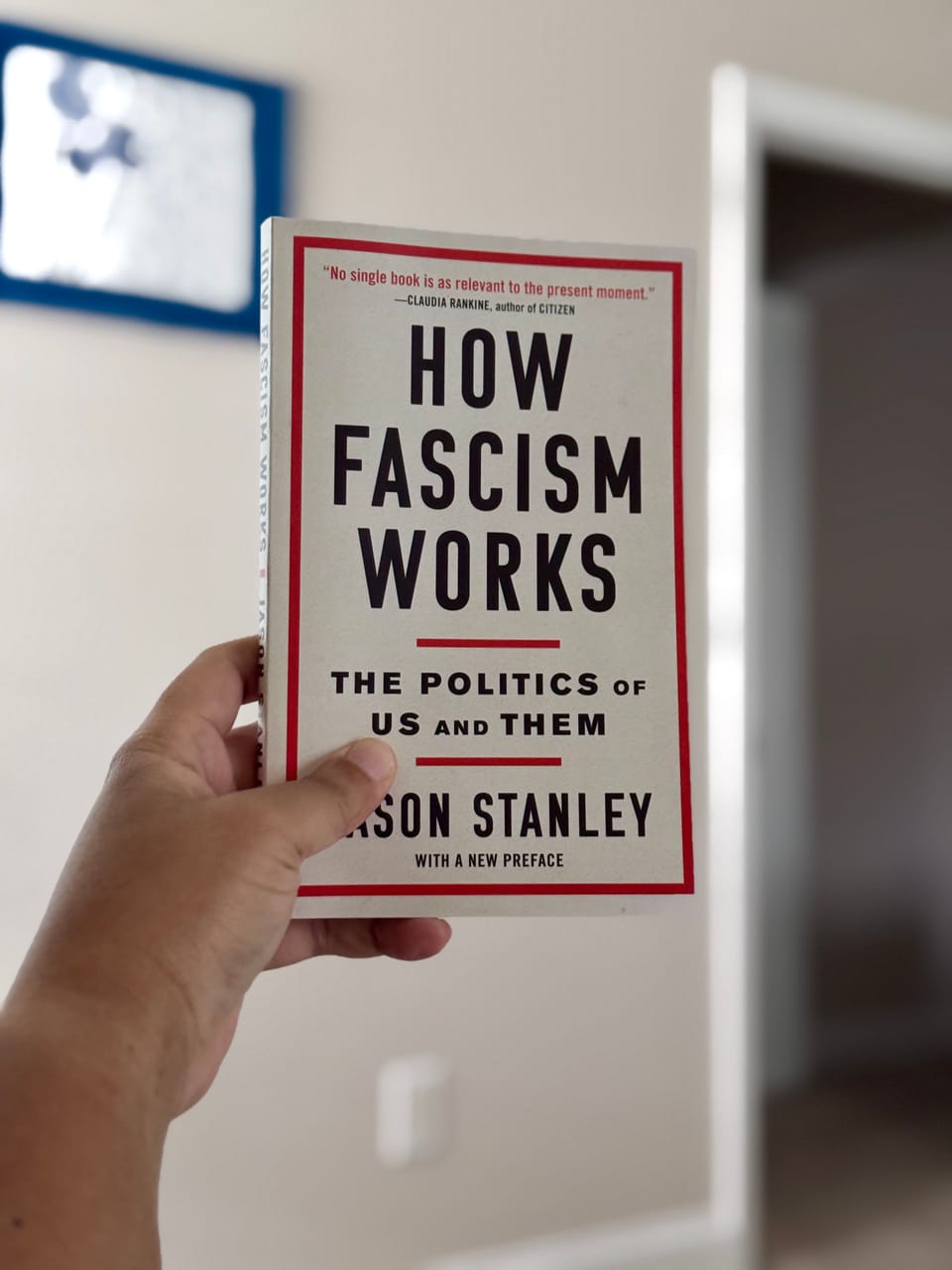
How Fascism Works by Jason Stanley is under 200 pages and examines 10 pillars to show how democracies can slide into fascism. He uses both historical and current examples to bolster his argument. The author's family background and his field of study give him a unique perspective on examining fascist patterns. However, it does stand out that he doesn't discuss Israel and Palestine as an example to make some of his points. Even with that omission, he does sample examples from Nazi Germany, Hungary, India, Myanmar, the US, and Britain. The strength of the book is that it is clear and an accessible introductory text to fascism. It also led me to speed up my timeline to pick up further reading, such as Du Bois and Franz Fanon.
While reading this book, I thought of The Message by Ta-Nehisi Coates. In the first part, he writes to writers: "For you, there can be no real distance between writing and politics." He goes on to say on writing, "The goal is to haunt—to have them think about your words before bed, see them manifest in their dreams, tell their partner about them the next morning, to have them grab random people on the street, shake them and say, '" Have you read this yet?" Stanley brings up his family history, and it seems to inform his politics; you can see that bleed through his words. However, the earnestness "to haunt" the reader is missing.
My main complaint with this book is that it can feel redundant at times and lacks much depth. A lot of the pillars overlap and bleed into each other. I thought it never went any further than an introductory text. I found myself wanting the author to offer some deep analysis. In some ways, I left the book wanting more. The author provides no next steps, not even to pay attention to local elections to minimize the spread of fascist policies. I was also unclear who this book was for.
Another book that came to mind was Jesus and John Wayne by Kristin Kobes Du Mez. That book talked about how white American evangelicals intertwine their faith with their politics and the evolution of "God-and-country faith." Stanley focuses on a country's internal "us vs them" mentality, but Du Mez touches on how America's belief in the country's supremacy regulated our military to the world's police, and with that comes the division of the world into good guys and bad guys. This, in turn, shapes how immigration is discussed and how immigrants are viewed. Even with attempting "assimilation," people of color are still considered as the "them" in the US.
Overall, I enjoyed the book and gave it a 4⭐️. It made me ask, "Has the US ever been fully democratic?" It seems the 'us vs. them' politics was baked in from the nation's inception. I would recommend this as a good step one, but it definitely requires further reading for deep analysis and strategy.
If you need some more recommendations, check out my Goodreads or StoryGraph. And then follow me on Instagram and Threads. One of my favorite newsletters to read for current events is Morning Brew. Check it out.